
Best CRM for Startups and Small Businesses in 2026
Discover the best CRM software for startups and small businesses. Compare Corenn, EngageBay, Attio and other budget-friendly CRM platforms.

Ready to scale your business?
Get professional design and development capacity without hiring overhead. Consistent quality, predictable costs, always available.
Get startedManaging customer relationships effectively becomes essential as soon as your startup starts gaining traction. However, most mainstream CRM platforms like Salesforce, HubSpot, Pipedrive, and Keap charge premium prices that can strain early-stage budgets. If you're reading this article, you likely need better alternatives that offer solid functionality without the enterprise price tags.
The CRM market has evolved to include many budget-conscious options specifically designed for startups and small businesses. These platforms provide essential customer management features, sales pipeline tracking, and automation capabilities at affordable prices or completely free. Rather than compromising on growth by avoiding CRM altogether, smart startups are choosing these cost-effective alternatives to build strong customer relationships from day one.
This guide examines the best free and affordable CRM options for startups, agencies and small businesses in 2026, focusing on platforms that offer genuine value without hidden costs or restrictive limitations that make them unusable for real businesses.
If you're an agency: Start with Corenn (Formerly ProRequests.com)
Before exploring general CRM options, agencies and service-based businesses should consider Corenn - a platform built specifically for your needs. Unlike general CRMs designed for sales teams, Corenn combines client portal functionality with CRM features tailored to agency workflows.
Corenn - Agency-focused client portal and CRM
Built by Tarkle, Corenn understands the unique requirements of creative agencies, marketing firms, and service businesses. The platform integrates client relationship management with project delivery, communications, and billing in one place rather than requiring multiple disconnected tools.
Agencies get white-label client portals branded with their identity, presenting professional experiences to clients while Corenn handles the infrastructure. The integrated CRM tracks client relationships, project history, and billing information alongside active project work. Custom inquiry forms capture leads directly into the system, while project management and file sharing keep client work organized.
The platform includes built-in billing and payment processing, eliminating separate invoicing tools. Clients access dedicated portals showing their projects, files, and communications without seeing other clients' information or navigating complex agency systems.
Corenn offers a 14-day trial allowing agencies to evaluate whether the integrated approach fits their workflow. After the trial period, pricing starts at $59 monthly, positioning it affordably for small agencies and service businesses building client bases.
Best for: Creative agencies, marketing firms, and service-based businesses needing integrated client portal and CRM functionality under their own branding.
Not an agency? The platforms below serve general startups, sales teams, and businesses without agency-specific requirements. Continue reading for CRM options better suited to your needs.
Understanding free CRM limitations and reality
True "free forever" CRMs are rare in the business world. Most platforms advertising free plans use them as entry points to paid subscriptions, with significant limitations on contacts, features, or users. Understanding these restrictions helps you choose the right platform for your actual needs rather than being surprised later.
Contact limits represent the most common restriction. Free plans typically support between 200-500 contacts, which may seem adequate initially but can become limiting as your startup grows. Some platforms offer more generous limits, while others require upgrades once you exceed basic thresholds.
Feature restrictions often limit automation, advanced reporting, or team collaboration features to paid plans. This means you might get basic contact management and pipeline tracking for free, but need to pay for email sequences, advanced analytics, or multi-user access that growing businesses require.
User limitations restrict how many team members can access the CRM simultaneously. Many free plans support only 1-3 users, making them suitable for solo founders or very small teams but inadequate for growing companies with sales and marketing teams.
Integration constraints may limit connections to other business tools like email marketing platforms, accounting software, or productivity apps that startups rely on for daily operations.
The key is finding platforms that offer sufficient functionality for your current stage while providing affordable upgrade paths as you grow, rather than platforms that use free plans as barely functional demos.
Top free and affordable CRMs for startups
EngageBay
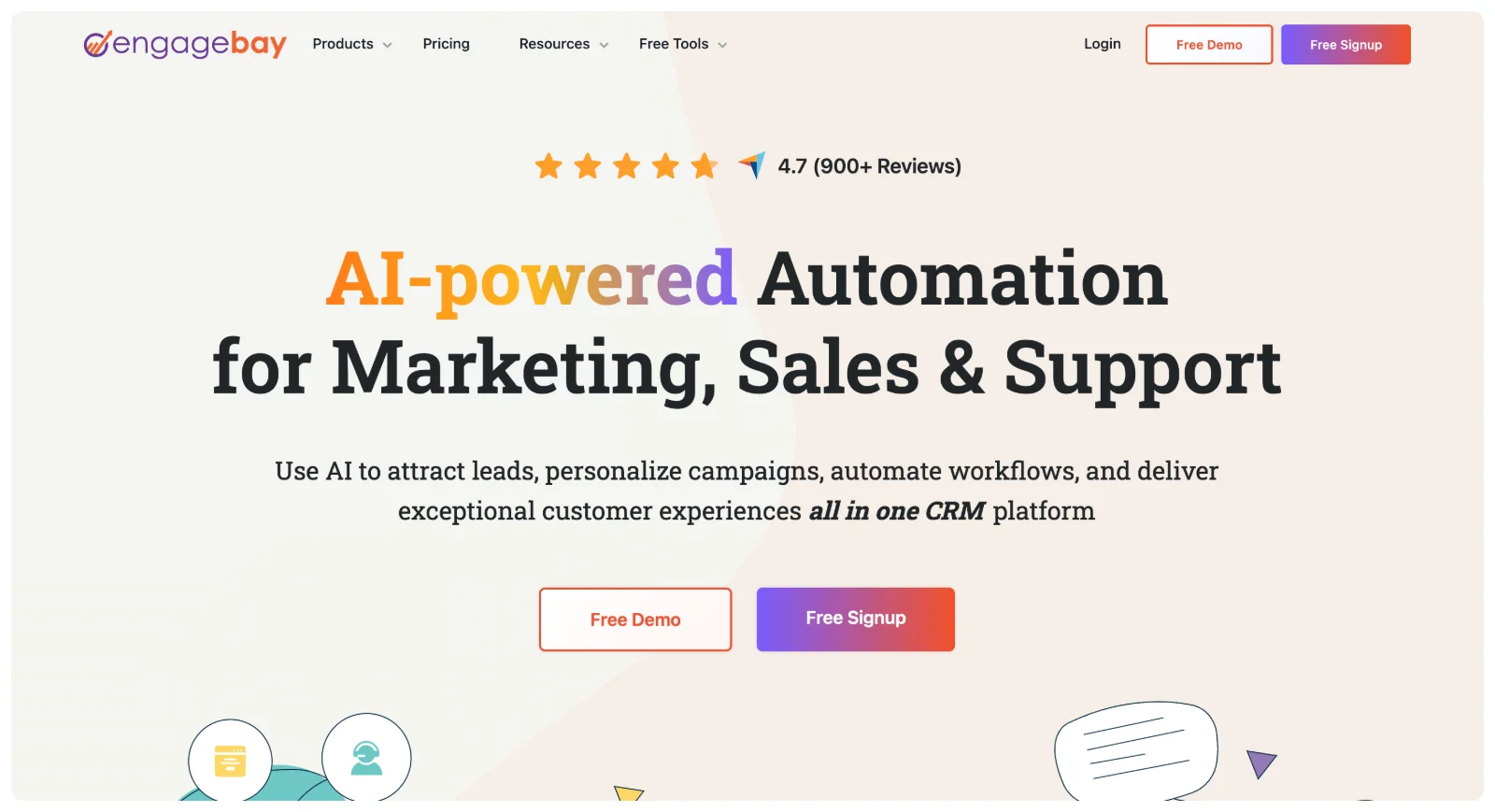 EngageBay stands out as one of the most generous free CRM platforms available, offering genuine utility rather than just a basic demo. Founded as an affordable alternative to expensive enterprise solutions, EngageBay provides integrated marketing, sales, and customer service tools in one platform.
The free plan supports up to 250 contacts with essential CRM features including contact management, deal tracking, appointment scheduling, and basic email marketing capabilities. This makes it suitable for startups needing real functionality without immediate financial commitment.
What distinguishes EngageBay from other free options is the inclusion of marketing automation features typically reserved for paid plans. Users get access to email templates, basic workflow automation, and lead nurturing sequences that can drive business growth from the start. The visual sales pipeline uses drag-and-drop deal management making it intuitive for teams without CRM experience.
The platform includes integrated helpdesk and live chat functionality, landing page builder, and form creation tools. This comprehensive approach means startups can manage customer relationships, marketing campaigns, and support requests through one system rather than piecing together multiple tools.
Pricing: Free for up to 250 contacts. All-in-one paid plans start at $14.99 per user monthly
Best for: Startups wanting comprehensive CRM with marketing automation without upfront investment
Attio
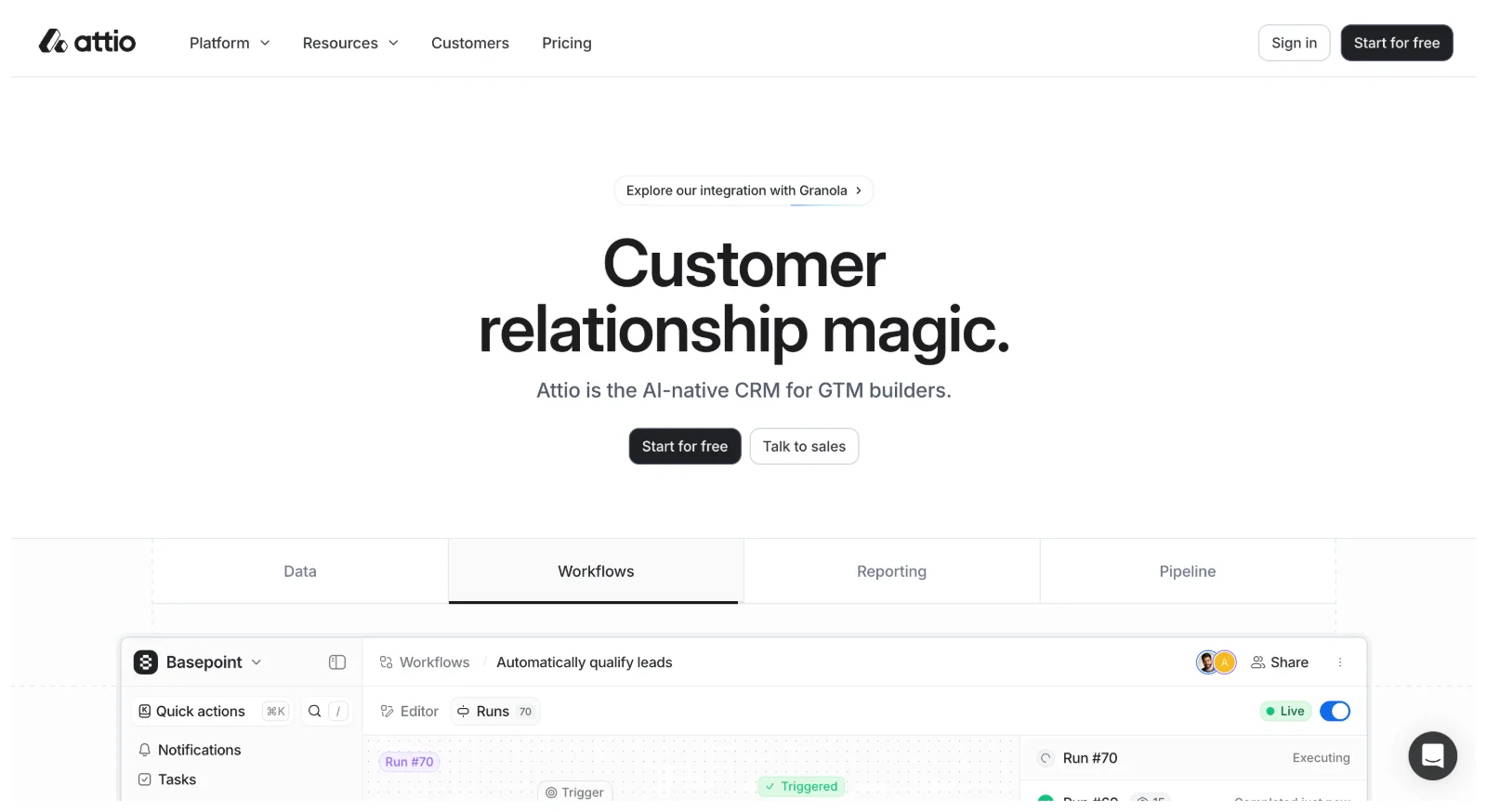 Attio represents the new generation of CRMs built specifically for startups and growing businesses. Founded in 2019 by entrepreneurs who experienced traditional CRM limitations firsthand, Attio offers a highly customizable platform that adapts to unique business models.
The free plan supports up to 3 users with 50,000 records, making it more generous than most competitors for very small teams. The Notion-style interface makes it intuitive for teams already familiar with modern productivity tools, reducing learning curves and setup time.
Attio's strength lies in its flexibility. You can create custom objects, fields, and workflows to match your specific business processes rather than adapting to rigid CRM structures. This proves particularly valuable for startups with innovative business models that don't fit traditional sales frameworks.
The platform provides automatic data enrichment for contacts and companies, pulling in relevant information from public sources to fill out profiles without manual data entry. Real-time collaboration features include team comments and mentions keeping everyone aligned. Email and calendar integration consolidates workflow, while AI-powered features enhance productivity across common tasks.
Pricing: Free for up to 3 users and 50,000 records. Paid plans start at $29 per user monthly
Best for: Startups needing flexible CRM that adapts to unique business processes
Folk
 Folk targets modern startups with its clean, spreadsheet-like interface that feels familiar to teams transitioning from basic tools. Launched in 2019 by eFounders, Folk focuses on relationship management for various business functions including sales, recruiting, and partnership development.
The platform offers a 14-day free trial with premium features, then requires paid subscription. However, Folk's pricing remains affordable for startups, starting at $25 per user monthly with annual billing discounts available.
Folk excels at contact enrichment, automatically filling in company details, social profiles, and other relevant information to save manual data entry time. The Chrome extension enables easy contact capture from LinkedIn, Gmail, and other platforms directly into the CRM, making it simple to build your database as you network.
Email sequences and template management help teams automate outreach while maintaining personalization. Collaborative pipelines with team sharing capabilities ensure everyone sees the same relationship data and deal progress without duplication or confusion.
Pricing: 14-day free trial, then $25 per user monthly (20% discount for annual billing)
Best for: Modern startups wanting user-friendly CRM with strong social media integration
Streak
 Streak takes a different approach by embedding CRM functionality directly into Gmail, making it perfect for startups already using Google Workspace. Rather than requiring separate software, Streak transforms your email inbox into a powerful relationship management system.
The free plan includes basic pipeline management, email tracking, and mail merge capabilities for individual users. This makes it ideal for solo founders or very small teams that live primarily in Gmail and want to avoid additional software complexity.
Streak's email-centric approach means all customer communications automatically connect to the right deals and contacts. Features like open tracking, click tracking, and scheduled sending help startups understand prospect engagement and time their follow-ups effectively. Customizable pipelines use drag-and-drop deal management directly within Gmail.
Mail merge capabilities enable personalized bulk email campaigns without leaving your inbox. Mobile apps for iOS and Android extend functionality beyond desktop, allowing relationship management while traveling or working remotely.
Pricing: Free forever for basic features. Pro plans start at $59 per user monthly
Best for: Gmail-heavy startups wanting CRM functionality without switching platforms
Zoho CRM
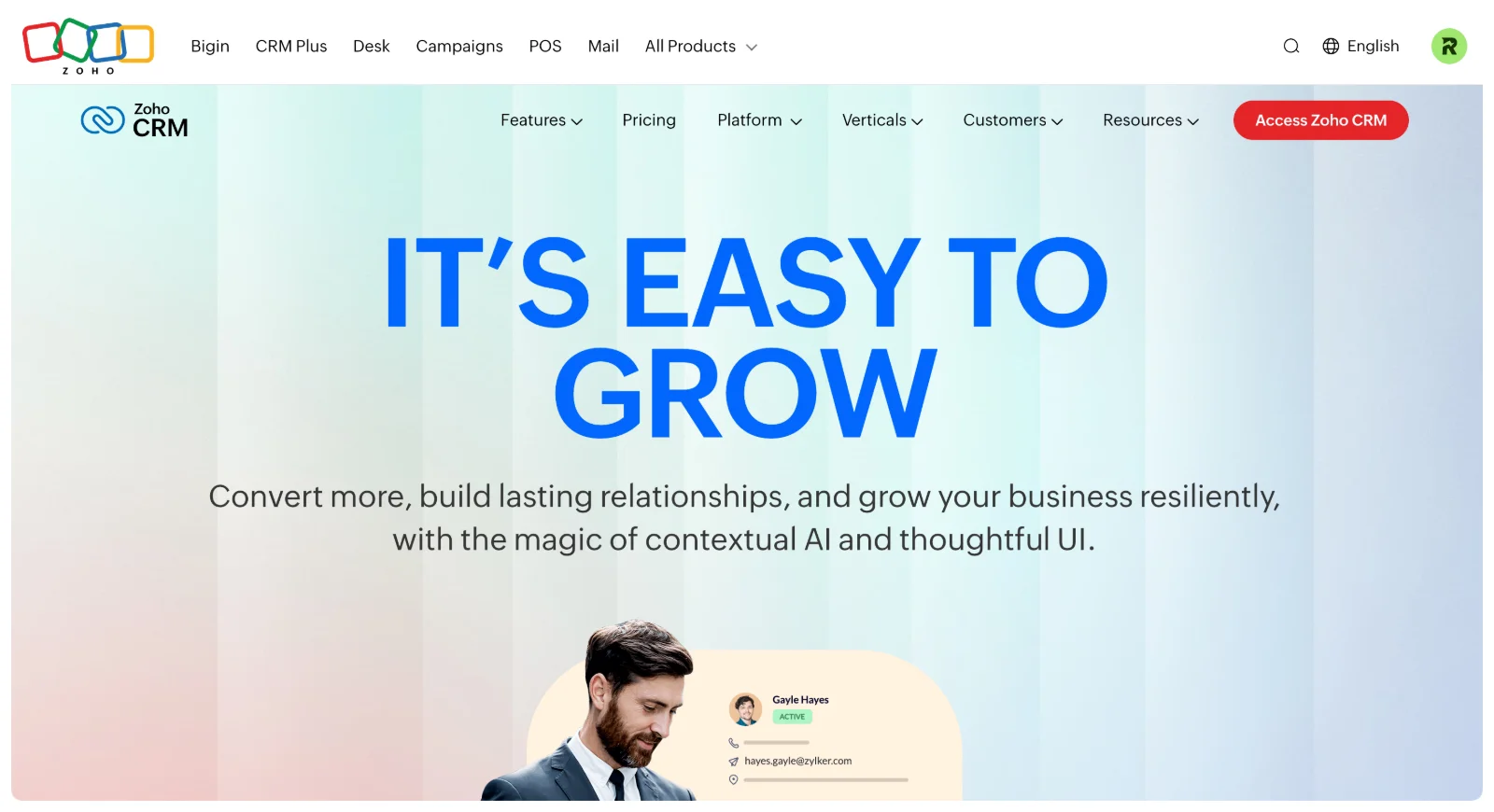 Zoho CRM offers one of the most established free plans in the CRM market, supporting up to 3 users with essential sales management features. As part of the broader Zoho business suite, it integrates well with other productivity tools startups might already use.
Stop overpaying Deel to manage contractors
Manage up to 25 contractors for $99/month instead of Deel's $500/month. Pay directly via Wise/PayPal. No middleman holding your money. Save $5,000/year.
See Kontrable
The free version includes contact management, deal tracking, basic reporting, and email integration. While not as feature-rich as some newer alternatives, Zoho provides reliable functionality with the backing of a mature software company that's been refining their product for years.
Zoho's advantage lies in its ecosystem approach. Startups can access complementary tools like Zoho Books for accounting, Zoho Campaigns for email marketing, and Zoho Projects for project management with shared data integration. This unified approach eliminates data silos common when cobbling together different vendors.
Basic sales automation and workflow capabilities help teams streamline repetitive tasks. Mobile CRM apps enable field sales activities and on-the-go relationship management. The platform scales affordably as teams grow, with standard plans starting at just $20 per user monthly.
Pricing: Free for up to 3 users. Standard plan starts at $20 per user monthly
Best for: Startups wanting established CRM platform with business suite integration options
Notion
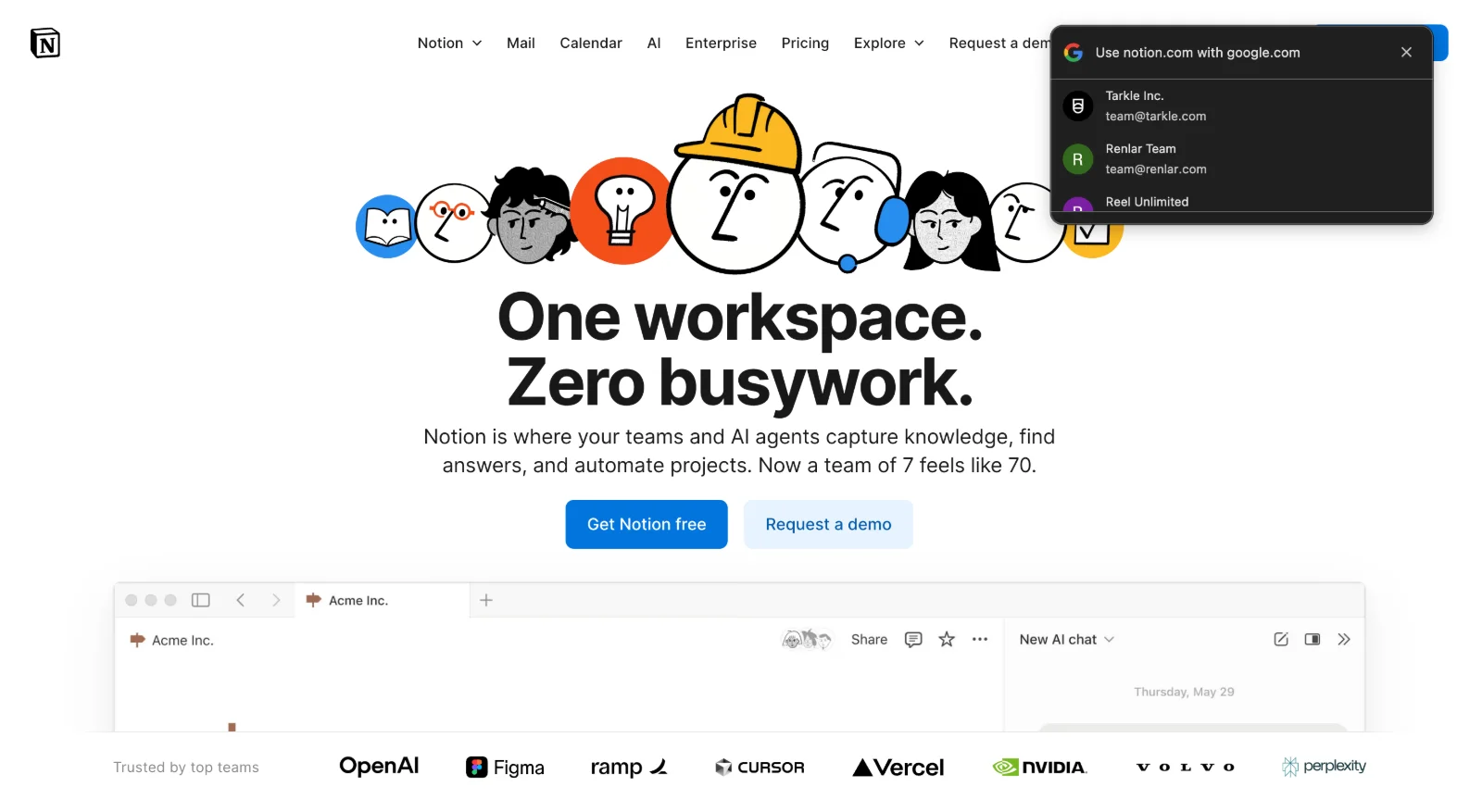 Notion offers unique CRM capabilities through its database and template features, making it popular among startups already using Notion for documentation and project management. While not a dedicated CRM, Notion's flexibility allows teams to create custom relationship management systems.
The free plan supports unlimited personal use with basic collaboration features for small teams. Startups can build custom CRM templates with contact databases, deal tracking, and automated workflows using Notion's formula and automation capabilities.
Notion's strength lies in its all-in-one workspace approach. Teams can manage customer relationships alongside project documentation, meeting notes, and strategic planning without switching between multiple tools. This consolidation reduces context switching and keeps all business information in one searchable location.
Customizable database templates allow matching your specific contact management needs. Flexible relationship tracking and deal pipelines adapt to various sales processes. Automation capabilities through formulas and triggers handle routine tasks without manual intervention.
Pricing: Free for personal use. Team plans start at $12 per user monthly
Best for: Startups already using Notion wanting to consolidate relationship management with existing workflows
Implementation strategies by business type
Different startup types and team structures benefit from specific CRM approaches. Consider your current situation and growth plans when making your selection.
Solo founders and very small teams should prioritize platforms with generous free tiers that provide immediate utility. EngageBay offers the most features without cost, while Attio provides superior customization for unique business models. For individual users living in Gmail, Streak's native integration eliminates software switching.
Service-based and agency businesses need client portal functionality alongside CRM capabilities, making Corenn particularly valuable with its integrated approach. The white-label capabilities and project management features match agency workflows better than sales-focused CRMs.
Teams already using Notion can leverage existing workspace investments by building custom CRM databases, avoiding additional software costs while maintaining workflow integration. This works well for startups prioritizing all-in-one workspace consolidation over specialized CRM features.
Growing teams anticipating rapid scaling should consider platforms with clear upgrade paths. Zoho's ecosystem approach provides tools across business functions as needs expand. Attio's flexibility accommodates changing processes without requiring platform migration.
The role of design in customer relationship success
Effective CRM implementation goes beyond software selection - it requires professional customer-facing materials that build trust and reinforce brand credibility. Startups that track customer relationships effectively but lack quality creative assets struggle to capitalize on their relationship insights.
Consider a startup using CRM data to identify high-value prospects but lacking professional presentations, proposals, or marketing materials to engage them effectively. The relationship insights become less valuable without corresponding creative assets that communicate professionalism and competence.
Similarly, businesses discovering through CRM analytics that certain customer segments respond well to specific messaging need branded email templates, landing pages, and marketing materials that implement these insights consistently across all touchpoints.
Your CRM reveals valuable insights about which prospects to target and what messaging resonates - but turning those insights into sales requires professional creative assets that match the sophistication of your relationship intelligence.
How professional design supports CRM-driven growth
Customer relationship management provides data about who to contact and what messages work. Converting those insights into revenue requires professional design quality across every customer touchpoint - presentations that close deals, email templates that drive engagement, landing pages that convert prospects, and brand materials that build trust.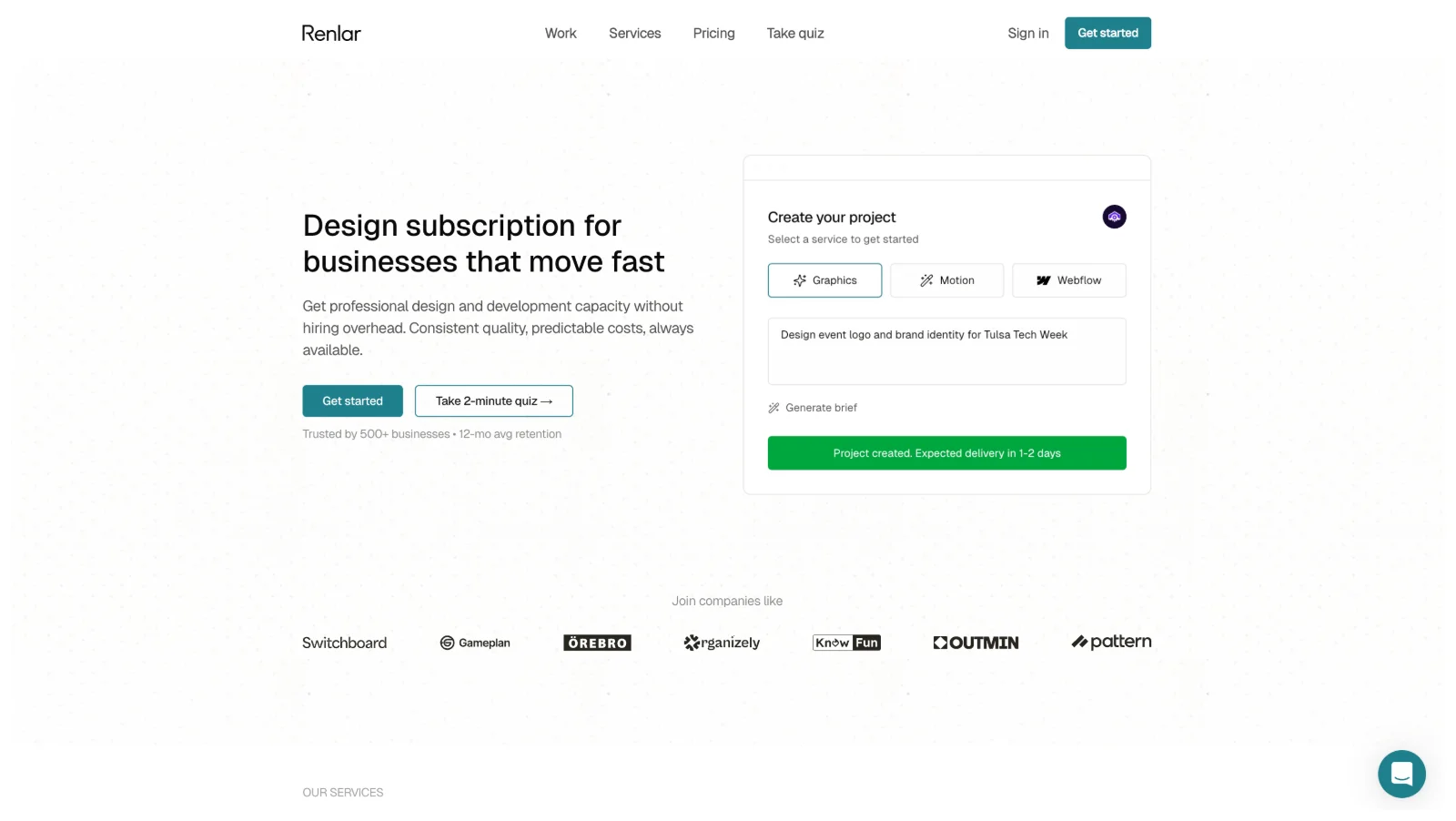 Renlar helps businesses bridge this gap between relationship intelligence and revenue execution through unlimited design and development services. Since launching, we've helped agencies and startups create the marketing materials needed to effectively act on their CRM insights and grow their businesses.
Professional presentations and proposals convert qualified prospects identified through CRM analysis. Email templates for automated sequences and nurture campaigns implement messaging strategies validated through relationship data. Landing pages optimized for lead capture feed qualified prospects back into your CRM. Marketing materials tailored to customer segments identified in your analytics speak directly to different audience needs.
Service structure:
Graphics ($1,295/month): Unlimited graphic design and video editing for presentations, marketing materials, and brand assets supporting sales efforts
Bundle ($1,995/month): Graphics plus complete website design and Webflow development for conversion-focused sites integrating with your CRM
Agency ($2,495/month): Full services with white-label capabilities for agencies building client materials
All services operate through monthly subscriptions without contracts, allowing flexibility as your business and CRM needs evolve.
Common CRM implementation mistakes to avoid
Startups often make predictable mistakes when implementing CRM systems that reduce their effectiveness and waste time. Avoiding these issues helps you get better results from whichever platform you choose.
Data quality problems occur when businesses rush to import existing contacts without cleaning up duplicate entries, incomplete information, or outdated details. Starting with clean, organized data makes your CRM more effective from day one rather than creating confusion later.
Over-complication happens when startups try to use every available feature instead of focusing on essential functionality. Begin with basic contact management and pipeline tracking, then add advanced features as your team becomes comfortable with the system.
Insufficient team training leads to inconsistent usage and data entry, reducing the CRM's value. Ensure all team members understand how to use the system properly rather than assuming intuitive adoption will occur naturally.
Integration neglect results in data silos when CRM systems don't connect properly with email marketing, accounting, or other business tools. Plan integration requirements early to maintain data consistency across your business systems.
Process documentation becomes crucial as teams grow. Document your CRM workflows, sales processes, and data entry standards so new team members can maintain consistency without extensive training periods.
Getting started with CRM implementation
Successful CRM implementation begins with clear understanding of your current customer management challenges and desired outcomes. Rather than choosing software first, identify specific problems you want to solve and workflows you want to improve.
Data preparation should happen before selecting any CRM platform. Organize your existing contact information, clean up duplicate entries, and standardize data formats. This preparation makes migration smoother regardless of which platform you choose.
Process design involves mapping your current sales and customer management workflows, then identifying areas for improvement through CRM automation. Understanding these processes helps you configure the chosen platform effectively rather than recreating inefficient manual workflows.
Team involvement ensures better adoption rates and more effective usage. Include all team members who will use the CRM in the selection process, and gather input on required features and workflow preferences before making final decisions.
Gradual implementation works better than attempting to migrate everything simultaneously. Start with basic contact management and deal tracking, then gradually add advanced features like automation and reporting as your team becomes comfortable with the system.
Making your CRM choice
The platforms examined in this guide provide genuine alternatives to expensive enterprise CRMs while delivering functionality that growing startups actually need. Agencies should start with Corenn's 14-day trial to evaluate whether integrated client portal and CRM functionality matches their workflow needs.
For general startups, EngageBay offers the best combination of features and value in the free tier, while teams ready to invest from the start should consider Folk for modern user experience or Attio for maximum customization. Gmail-heavy organizations benefit from Streak's native integration, and teams already using Notion can leverage existing workspace investments.
Remember that CRM success requires more than software selection. Your relationship insights need professional creative assets to convert prospects into customers. Whether you choose free platforms or invest in paid solutions, ensure your CRM data translates into compelling presentations, proposals, and marketing materials that build trust and drive revenue.
The right CRM matches your business type, team size, and growth stage. Agencies need different tools than sales teams. Solo founders have different requirements than growing companies. Choose based on your actual situation, not theoretical future needs, then upgrade as your business evolves.
Ready to scale your business?
Get professional design and development capacity without hiring overhead. Consistent quality, predictable costs, always available.
Get started