
DotYeti Review and Alternatives in 2026
DotYeti review - does boutique design positioning justify $995-$3,995/month with 2 concurrent request limits? Honest comparison with alternatives.

Ready to scale your business?
Get professional design and development capacity without hiring overhead. Consistent quality, predictable costs, always available.
Get startedThe tension nobody talks about: DotYeti charges boutique pricing ($995-$3,995 monthly) but limits you to 2 concurrent requests across all tiers except their top Apex plan. You're paying for premium positioning while still queuing work sequentially like budget services.
This creates an interesting question: What exactly are you paying for? If operational capacity stays limited regardless of price tier, the premium must come from somewhere else - team expertise, client experience, specialized capabilities, or brand positioning itself.
DotYeti was acquired by FE International in January 2024 for undisclosed terms, marking them as successful enough to attract acquisition interest. They serve HubSpot, Best Western, Autodesk, TikTok, and WWF UK - legitimate enterprise clients validating their quality. But does success and client roster justify paying $2,595 monthly while still limited to 2 simultaneous projects?
What "boutique" actually means here
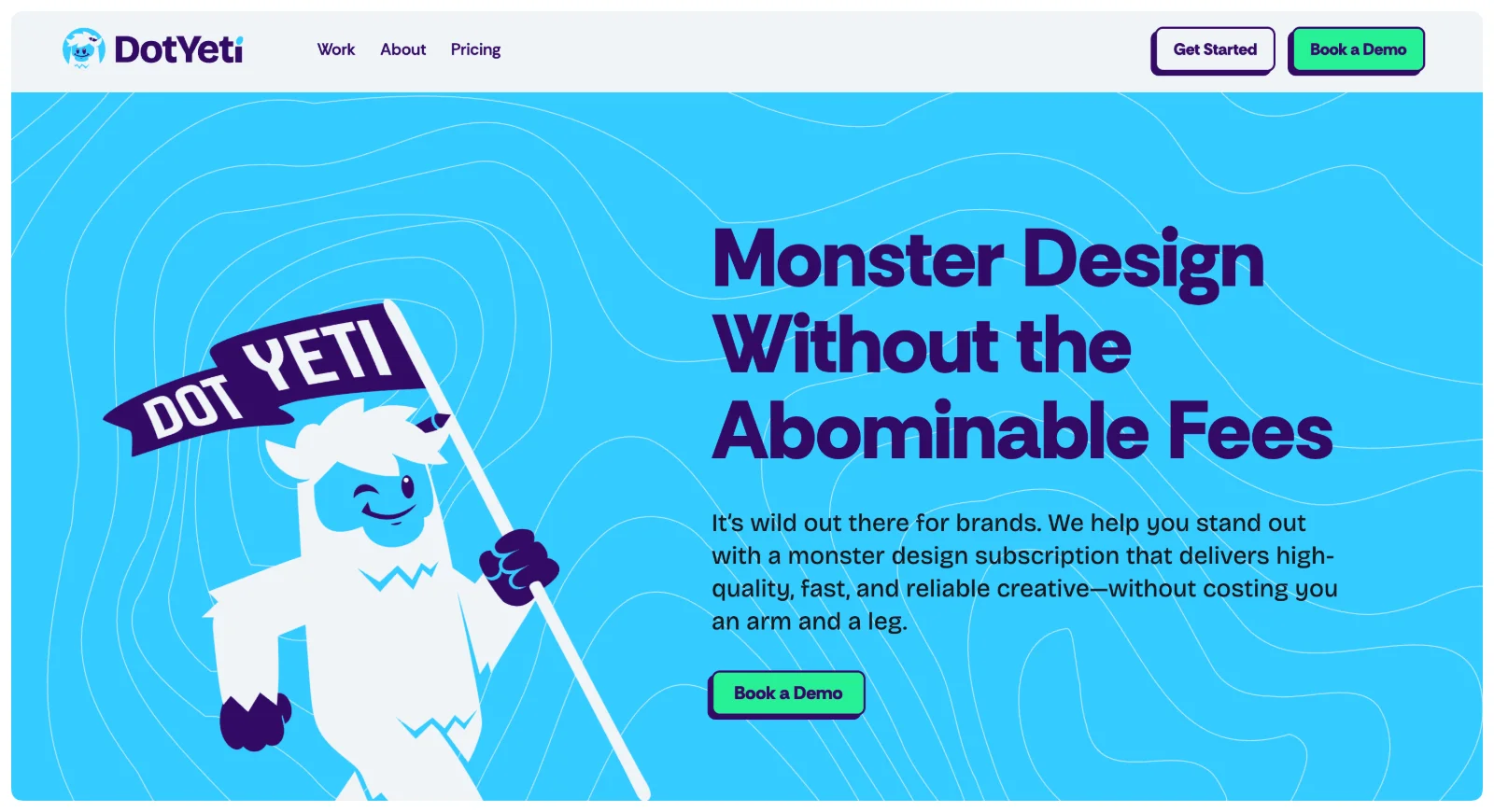 DotYeti founded in 2020 positions as solving "the biggest, hairiest creative challenges" for modern brands. The boutique framing emphasizes personalized relationships over transactional service - they're "an independent design shop" building lasting partnerships rather than treating businesses as "data points on a growth chart."
The team structure reflects specialized roles: Art Yeti, Motion Yeti, Creative Yeti, Copy Yeti. This naming convention creates personality around what could otherwise be generic "graphic designer" and "motion designer" titles. Whether you find this charming or gimmicky depends on your tolerance for branded team nomenclature.
Services span graphic design, illustrations, presentations, logos/branding, animated GIFs, video ads, motion graphics, video editing, web design, copywriting, 3D design/animation, and advanced CGI. The breadth is genuinely comprehensive - few competitors offer 3D/CGI alongside standard graphic design.
Platform includes AI-powered brief generation and project management, attempting to streamline traditionally painful aspects of working with design services. Visual annotation tools, real-time tracking, and integrated feedback systems address common friction points.
They offer 14-day money-back guarantee and unlimited revisions, standard for the category but worth noting. The acquisition by FE International suggests operational profitability and client retention metrics attractive enough for acquisition multiples.
Four tiers, all capacity-limited
Base: $995/month 2 concurrent requests, 2 brand profiles, 2-3 business day turnaround, basic graphic design
Scale: $1,595/month 2 concurrent requests, unlimited brand profiles, 1-3 business day turnaround, dedicated art director, logo/branding, animated content
Summit: $2,595/month 2 concurrent requests, priority turnaround, dedicated account manager, live support, motion graphics, video editing, web design, copywriting, 3D design
Apex Studio: $3,995/month 3+ concurrent requests, expedited turnaround, campaign strategy, advanced 3D animation, custom web development, CGI, AI video production
Notice the pattern: Base, Scale, and Summit all limit to 2 concurrent requests. Only Apex (starting at $3,995) increases capacity to 3+. You're paying $600-$1,600 more between tiers primarily for service scope and turnaround speed rather than capacity increases.
This matters operationally. If you need homepage redesign, social graphics, email templates, and presentation deck simultaneously, three of those four projects queue regardless whether you're paying $995 or $2,595 monthly. The concurrent limit constrains throughput independent of pricing tier.
The capacity vs pricing disconnect
Here's where boutique positioning creates tension with operational reality:
Services charging $1,295-$1,995 typically provide 2-3 concurrent projects. Services charging $2,495-$2,995 typically provide 4-5 concurrent projects. DotYeti charges $995-$2,595 while maintaining 2 concurrent limits across three of four tiers.
You could argue: "But you're paying for specialized expertise, dedicated account management, and advanced capabilities like 3D/CGI!"
Fair point. Except operational capacity directly impacts business outcomes. If you have four urgent needs and can only progress two, your bottleneck is capacity not expertise. Premium pricing without corresponding capacity increases means you're paying for positioning rather than operational improvement.
The Summit tier at $2,595 provides motion graphics, video editing, web design, copywriting, and 3D design - genuinely valuable capabilities. But you still queue work through 2 concurrent slots. A service charging $1,995 with 4 concurrent slots potentially delivers faster despite fewer advanced capabilities simply through parallel processing.
What justifies the boutique premium?
If not capacity, what are you actually buying at $995-$3,995 monthly?
Specialized capabilities - 3D design, advanced CGI, AI video production exist at higher tiers. Competitors rarely offer these. If your business needs 3D product renders or CGI content, DotYeti provides this without managing separate specialized vendors.
Named team consistency - The Art Yeti, Motion Yeti approach creates personality around team relationships. Some businesses value knowing specific people rather than working with anonymous "designers." Whether this justifies premium pricing depends on your relationship preferences.
Enterprise client validation - Working with HubSpot, Autodesk, and TikTok demonstrates capability handling enterprise requirements. If brand association matters for your business credibility, this positioning provides social proof.
Platform sophistication - AI-powered brief generation, visual annotation, integrated project management attempt solving real pain points. Whether these tools justify premium pricing depends on how much briefing and feedback currently frustrate your workflows.
Dedicated account management - Summit tier provides dedicated account managers handling coordination complexity. This matters for businesses wanting single-point-of-contact simplicity over direct designer communication.
Boutique experience positioning - Some businesses prefer "boutique partner" relationships over "service vendor" transactions. If this psychological framing matters for your team buy-in or executive approval, the positioning itself creates value.
Consider Renlar as an alternative
Renlar provides unlimited design services through monthly subscriptions for agencies and marketing teams.
Learn moreWhen boutique positioning actually matters
You need 3D/CGI capabilities - Few design subscriptions offer advanced 3D animation and CGI content. If your business requires product visualizations, architectural renders, or advanced visual effects, DotYeti's Apex tier provides this without managing specialized vendors separately.
You have consistent need for 2 projects simultaneously - If your actual concurrent needs rarely exceed 2 projects, the capacity limitation doesn't constrain you. Paying for execution quality and advanced capabilities makes sense when capacity isn't your bottleneck.
You value dedicated account management - If direct designer communication creates coordination overhead for your team, having dedicated account managers at Summit/Apex tiers handling project traffic provides organizational value.
You want comprehensive service scope - Having motion graphics, video editing, 3D design, and copywriting under one vendor simplifies management versus coordinating multiple specialized services. The premium consolidates complexity.
Brand positioning matters internally - Sometimes "we work with boutique design partners" helps with internal buy-in or executive approval more than "we use a design subscription service." If positioning language matters for your organizational context, this has practical value.
When you're paying for positioning over performance
You frequently need 3+ concurrent projects - If you consistently have multiple urgent needs across categories, 2 concurrent slots create constant bottlenecks. Services with 4-5 concurrent capacity deliver faster despite potentially less sophisticated positioning.
Your budget is under $2,000 monthly - At $995-$1,595 for 2 concurrent requests, you're paying premium per-project costs. Alternatives at $1,295-$1,995 with 3-4 concurrent slots provide better throughput economics.
You don't need 3D/CGI/advanced capabilities - If your needs center on graphic design, video editing, and standard motion graphics, you're paying for capabilities you won't use. Better to access focused execution without boutique premium.
You prefer direct designer communication - If your team works well communicating directly with designers during business hours, account manager intermediaries add overhead rather than value. Time zone-aligned direct access may work better.
You're comparing turnaround vs capacity - DotYeti's 1-3 day turnaround per project seems fast until you realize services with 4 concurrent slots deliver four projects in 3 days while DotYeti delivers two. Parallel capacity often matters more than per-project speed.
The acquisition factor
FE International acquiring DotYeti in January 2024 provides interesting context. FE International specializes in buying profitable online businesses at 3-6x EBITDA multiples. This suggests:
DotYeti operates profitably - Acquisition requires positive unit economics and sustainable growth. They're not burning capital chasing growth at all costs.
Client retention works - Subscription businesses get valued on LTV/CAC ratios. Acquisition implies healthy retention metrics validating their boutique positioning.
Market sees subscription design value - Strategic buyers paying multiples for design subscription businesses validates the category. This isn't experimental - it's proven enough for M&A activity.
But acquisition also means: New ownership priorities may shift positioning over time. Early-stage startup energy evolves into portfolio company optimization. Whether this improves or degrades client experience depends on integration execution.
DotYeti alternatives
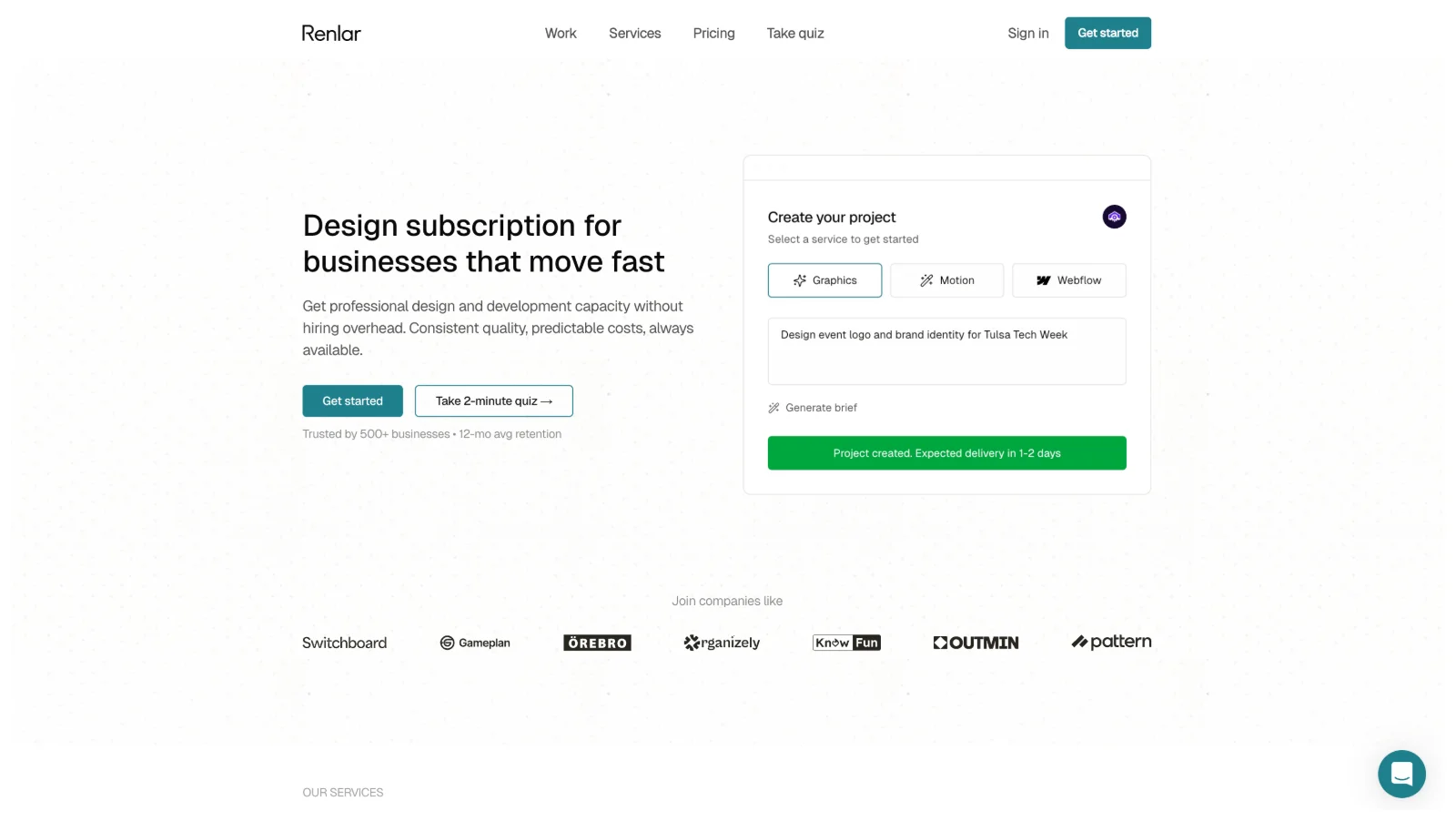 Renlar at $1,295-$2,495 monthly (approximately £1,000-£1,925) provides 2-4 concurrent projects across graphics, video, and website development. The concurrent capacity advantage matters for businesses with multiple simultaneous needs. No 3D/CGI capabilities, but professional execution across standard categories without boutique premium.
Kimp at $599-$995 monthly provides graphics and video with team-based delivery. Substantially lower pricing but also lower concurrent capacity. Works for businesses with genuinely limited needs not requiring multiple simultaneous projects.
Design Pickle at approximately $1,918 monthly focuses on graphic design with hours-based allocation. Different operational model entirely, suiting businesses comfortable with capacity planning through hours rather than concurrent projects.
These alternatives show the trade-off space: You can get more concurrent capacity at similar pricing (Renlar), much lower pricing with standard capacity (Kimp), or different operational models (Design Pickle). None offer DotYeti's 3D/CGI capabilities, but most businesses don't need those.
Making your decision
The right choice depends on what constraint actually limits your business.
If capacity is your constraint - Multiple urgent concurrent needs across categories mean 2 simultaneous slots create constant bottlenecks. Services with 4-5 concurrent capacity solve this regardless of boutique positioning.
If expertise is your constraint - Need for 3D visualization, advanced CGI, or specialized motion graphics means you're constrained by capability not capacity. DotYeti's advanced services solve this where general alternatives can't.
If coordination is your constraint - Managing multiple vendors or briefing designers creates organizational overhead. Consolidated service scope and dedicated account management reduce coordination burden, justifying premium pricing through efficiency.
If budget is your constraint - Limited marketing budgets can't accommodate $2,595 monthly even with justified capabilities. Better to access professional execution at $1,295-$1,995 with slightly less scope than stretch budget for boutique positioning.
Ask yourself honestly: Am I capacity-constrained or capability-constrained? Do I need 3D/CGI or standard graphics/video/web? Do I value boutique positioning or execution efficiency?
DotYeti excels at providing specialized capabilities (3D/CGI), comprehensive service scope (motion to copywriting to web design), and boutique client experience for businesses with $995-$3,995 monthly budgets where capacity rarely exceeds 2 concurrent needs.
For businesses needing 3+ concurrent projects regularly, the operational bottleneck outweighs boutique positioning. For businesses not requiring 3D/CGI capabilities, paying premium pricing for unused specialization wastes budget. For businesses under $2,000 monthly budgets, accessible alternatives provide professional execution without boutique premium.
Choose based on whether DotYeti's specific strengths - advanced capabilities, comprehensive scope, boutique positioning - align with your actual constraints. Don't pay for specialization or positioning advantages that don't solve your limiting factors.
Ready to scale your business?
Get professional design and development capacity without hiring overhead. Consistent quality, predictable costs, always available.
Get started